
What Makes Work-Truck Fleet Washing Different From Washing One Personal Vehicle?
Trash Titans Plus ·
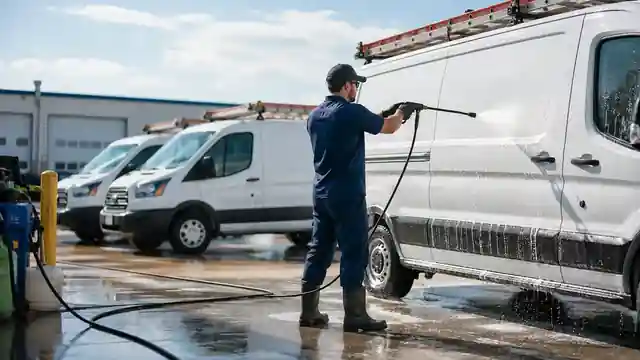
Washing one personal vehicle is simple to picture. You know the vehicle, you know where it is parked, and you can work around your own schedule. A work fleet adds a different set of questions before the first vehicle is touched.
How many units are there? Are they all the same type? When are they available? Are graphics or wraps involved? Is the fleet at one location? Are some trucks loaded with tools or equipment that change access?
Those details are why fleet washing starts with scope.
A fleet can be five versions of the same problem
A plumbing company may have pickups, cargo vans, and a box truck. An HVAC company may use several similar vans plus a supervisor vehicle. Another business may have service bodies with compartments, ladders, racks, and equipment mounted outside.
Calling all of them “work trucks” is accurate, but it does not make them identical.
Large flat panels show road film differently from a pickup bed. Wheel wells collect a different kind of soil than door panels. Ladder racks create extra edges and shadowed areas. Vehicle graphics can also change how dirt appears because high-contrast lettering makes a film easier to notice.
That is why the work-truck fleet washing page asks for vehicle count and type instead of treating every fleet as one standard package.
Scheduling is part of the cleaning job
A personal vehicle can often be washed whenever the owner has time. A work truck may need to leave for a job at 7:00 in the morning and return at 5:00 in the afternoon. Another may be on call. A third may stay at a jobsite overnight.
When several vehicles are involved, availability can be as important as the dirt.
A useful fleet quote should account for when the vehicles can actually be together. If only half the fleet is present at one time, that changes the plan. If the business needs every unit ready early the next morning, that matters too.
This is why it helps to include scheduling constraints in the first message instead of waiting until after a price is discussed.
Branded vehicles make small differences easier to see
A work van is transportation, but it is also moving company signage. White lettering on a dark wrap, a large logo on a box truck, or clean color blocks on a service van can make road film and streaking stand out.
The effect can work the other way too. A dusty gray pickup may hide dirt better than a glossy black vehicle with a bright logo.
That does not mean every fleet needs to look like a showroom. Work vehicles are supposed to work. They drive through rain, construction dust, winter residue, and parking lots. The practical goal is usually consistent presentation, not a fictional standard where a working vehicle never gets dirty.
Repetition changes the economics
When a business has several vehicles, setup time can be spread across more units. But the opposite can also happen if the fleet is scattered across locations, has major size differences, or requires unusual access.
That is why a public “per vehicle” number can be misleading without context.
The useful inputs are straightforward:
- How many vehicles are involved?
- What types are they?
- Where are they located?
- Are they normally together at the same time?
- What areas need attention?
- Is there anything unusual about graphics, equipment, access, or schedule?
The quote request gives you a place to send those details without needing a fleet-management spreadsheet or exact square footage.
Work fleets are different from refuse trucks
A service van and a refuse truck both get dirty, but they operate in very different environments. Refuse equipment can involve a different cleaning scope, different working areas, and different access questions.
Trash Titans Plus keeps those categories separate on purpose. If the equipment is a garbage or refuse truck, start with trash truck washing. If it is an HVAC, plumbing, service, or similar work fleet, start with fleet washing.
The distinction prevents a simple request from turning into the wrong assumption.
The first fleet-washing conversation
The first conversation should make the job clearer. It should not force the business owner to learn cleaning terminology.
A short description such as “eight service vans and two pickups, all parked at the shop after 6 p.m.” is already useful. Add the city or ZIP code and the main concern. If the vehicles have heavy seasonal road film, construction dust, or another obvious condition, say so.
From there, the real question is whether the location, count, timing, and scope fit together.
That is the biggest difference between washing one personal vehicle and washing a work fleet. The dirt still matters, but the operation around the dirt matters just as much.
Back to BlogFleet and work vehicles