
Rust, Oil, and Other Concrete Marks: What Cleaning Can and Cannot Change
Trash Titans Plus ·
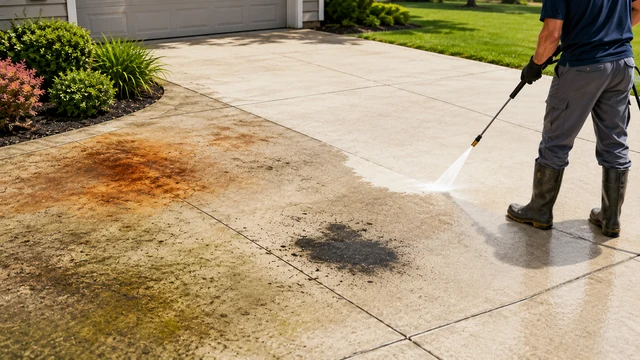
Concrete can look tough enough to handle anything, which is one reason people expect every mark to disappear once it is pressure washed. Then the driveway is cleaned and one dark oil shadow or orange rust mark is still visible.
The important distinction is simple: cleaning soil off concrete is not the same as reversing every chemical or absorbed stain in concrete.
Oil can move into the pores
Concrete has texture and porosity. A fresh drop of oil may sit near the surface. A leak that goes unnoticed can soak deeper over time.
Once material has penetrated below the top surface, the job is no longer just removing loose dirt.
That is why the age of the stain matters. It is also why a driveway with one old oil spot should not be sold the same expectation as a driveway with general dirt and organic buildup.
The driveway cleaning page is deliberately clear that not every mark is guaranteed to disappear.
Rust can involve a chemical color change
Orange or brown marks often appear where metal has been left on wet concrete, where fertilizer particles contained iron, or where another source introduced rust-producing material.
The visible color is not necessarily a layer that can be blasted off like mud.
Trying to solve every rust mark with more mechanical force can damage the concrete without fixing the stain.
The useful question is not “How much pressure can we use?” It is “What caused the color and what can realistically be improved?”
Tire marks are different again
Dark arcs near a garage can come from tire contact, friction, heat, and rubber transfer. They may resemble oil from a distance but behave differently.
This is why describing the location of a mark can help.
“Black curves where the tires turn into the garage” gives more context than “dark stain.”
You do not need to diagnose it yourself. You just want to make sure the cleaning company knows the mark deserves separate attention.
Organic buildup usually follows the environment
Green or dark areas often develop where the concrete stays damp longer. Shade, landscaping, leaf accumulation, soil splash, and drainage can create a visible pattern.
Those conditions are different from a petroleum stain or rust.
General cleaning may make a large improvement when the problem is surface buildup. That does not tell you anything about how an old oil spot will respond.
Several problems can exist on the same slab.
Why stronger pressure is not the universal answer
Pressure can remove material, but concrete has limits. Aggressive cleaning can etch or mark a surface.
Once the basic soil is removed, a stubborn stain may need a different treatment, more time, or a more modest expectation.
The broader pressure washing page explains why the method should follow the surface rather than the other way around.
Cleaning can reveal color differences that were already there
A dirty driveway can hide repairs, different concrete batches, old wear, and previous treatment.
After cleaning, those differences may become easier to see.
A repair patch may be lighter. A section near the road may have a different texture. Concrete that was once under a vehicle may age differently from an open section.
The cleaning did not necessarily create the variation. It may have removed the film that was disguising it.
Call out the stain before pricing
If there is a particular stain that matters to you, point it out before the scope is finalized.
Include:
- Where the mark is
- What you think caused it, if you know
- How long it has been there
- Whether anything has already been used on it
- The surface type
- Your city or ZIP code
If you used a product on the stain, say what it was if you remember. That can matter.
The quote form gives you space to separate the general driveway cleaning from a stain-specific concern.
What is a realistic goal?
A realistic goal is to improve the surface based on its current condition.
General dirt and organic buildup may clean very well. A deep oil shadow may lighten without vanishing. A rust-colored reaction may need special attention and may still leave evidence behind. Old concrete may show its age after the dirt is gone.
None of that makes cleaning pointless. It makes expectation-setting important.
The best result is not the most aggressive promise. It is a clear understanding of what is ordinary buildup, what is a specific stain, and what the concrete can reasonably look like after the work.
Back to BlogPressure washing and surfaces