
Organic Buildup on Driveways and Sidewalks: Why Shade and Moisture Change the Picture
Trash Titans Plus ·
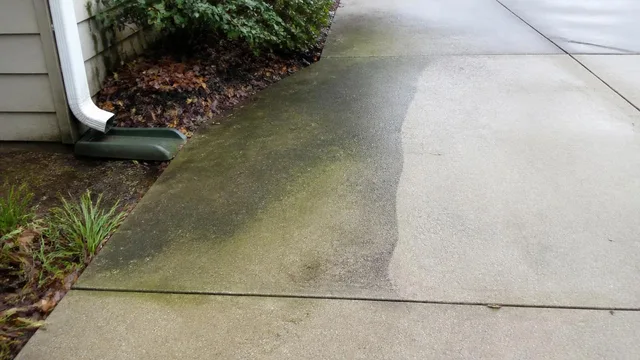
Two sections of concrete poured on the same day can age into very different-looking surfaces. One stays relatively bright. The other develops dark or green-looking buildup along the edge.
Often the difference is not the concrete. It is the environment around it.
Shade, moisture, drainage, landscaping, leaf debris, and soil splash can change how long a surface stays damp and how much organic material collects there.
Shade changes drying time
Sunlight helps a wet surface dry.
A driveway section beside the open street may dry quickly after rain. A sidewalk under trees or along the north side of a house can stay damp much longer.
The longer moisture remains on a textured surface, the more opportunity there is for organic buildup to become noticeable.
This is one reason the darkest section is often not the oldest section.
Low spots hold water differently
Concrete is rarely perfectly flat.
A small low area can hold water after the surrounding slab has dried. The puddle may be shallow enough that nobody notices it as a drainage problem but still deep enough to keep the surface damp.
If the same patch repeatedly darkens first, watch what happens after rain.
The pattern may explain more than the color alone.
Landscaping moves material onto concrete
Mulch, soil, grass clippings, pollen, leaves, and plant debris all travel.
Rain can splash soil onto the edge of a sidewalk. A mower can leave fine clippings along the drive. Wet leaves can sit against concrete for days.
That material becomes part of the surface film.
Cleaning the concrete can improve the appearance, but the surrounding source still exists. Regular sweeping and leaf removal can slow the return.
Downspouts can create a local pattern
Water leaving a downspout has to go somewhere.
If water repeatedly crosses the same section of concrete, that area receives more moisture than the rest.
The cleaning question and the drainage question should be kept separate. Cleaning can remove buildup. It cannot redesign the water path.
If a downspout or grading problem is creating standing water, that may need a different professional.
Organic buildup is not the same as oil or rust
Dark surface growth, petroleum staining, rust-colored marks, and tire transfer can all appear on a driveway.
They should not be treated as one problem.
The driveway cleaning page sets realistic expectations about stains. The sidewalk cleaning page does the same for walkways.
If one isolated mark is your main concern, mention it separately from the general dark buildup. For stain-specific expectations, see why driveway stains clean differently.
Why cleaning can look uneven at first
Once the surface film is removed, the concrete underneath may reveal natural variation.
One slab may be newer. A repair may have different color. A shaded section may have weathered differently. Old stain shadows may remain.
That is not automatically a failed cleaning job.
Concrete has a history, and dirt sometimes hides it.
Does stronger pressure prevent buildup from coming back?
No cleaning method can change the amount of shade or the direction of rain.
Using excessive force in an attempt to make the surface “stay clean longer” can damage concrete without changing the environmental conditions that caused the buildup.
The broader pressure washing page explains why force should be matched to the surface.
What can homeowners do between cleanings?
Basic maintenance helps:
- Sweep or blow leaves before they sit wet for long periods.
- Keep heavy mulch and soil from washing onto the concrete when practical.
- Pay attention to repeated standing water.
- Clear grass clippings from the edge after mowing.
- Deal with fresh spills early.
- Keep drainage questions separate from cleaning questions.
These habits do not eliminate every dark area. They reduce some of the material and moisture that feed the pattern.
When is it time to ask for a quote?
When the buildup is visible enough that it bothers you, when the walkway or driveway looks uneven, or when you want to clean several exterior surfaces together.
Send the location, the surfaces, and the areas that look worst.
The quote form lets you include a driveway, sidewalk, house exterior, deck, or several services in the same request.
Organic buildup is easiest to understand when you stop asking only “Why is the concrete dark?” and start asking “Why does this particular section stay different from the rest?” Shade, moisture, drainage, and nearby landscaping often provide the answer.
Tree cover changes more than sunlight
Trees create shade, but they also drop pollen, leaves, small twigs, seeds, and other organic material.
A driveway under a large canopy receives a different stream of material from a driveway in an open yard. The surface may need sweeping more often even when both homes are on the same street.
Branches can also slow air movement, which can affect drying after rain.
The combination of shade, debris, and slower drying helps explain why concrete under trees often changes appearance faster.
Mulch and bare soil create different edge patterns
A sidewalk beside dark mulch may develop a different border from one beside healthy turf.
Rain can move fine mulch particles onto the slab. Bare soil can splash. A raised landscape bed can send water across one section.
If the edge becomes dark quickly after cleaning, the source may be outside the concrete.
Changing that source can sometimes do more for long-term appearance than asking for stronger cleaning.
Repeated moisture can create a map of the property
Look at the dark areas after several days without rain.
If one strip stays darker, it may be holding moisture. If the area below a downspout is the only section that changes, the water pattern is telling you something. If the shaded north side stays different from the open south side, drying time is probably part of the picture.
These patterns are useful because they help separate ordinary buildup from isolated stains.
Why north-facing surfaces often get attention
In the Northern Hemisphere, the north side of a structure generally receives less direct sun than the south side.
At a house, that can mean siding, walkways, or concrete near the north side dries more slowly.
The exact pattern depends on trees, neighboring buildings, rooflines, and time of year, so direction is only one clue.
Still, homeowners often notice that one side consistently develops visible buildup first. That is not random.
Cleaning frequency should follow conditions
A concrete surface in full sun with good drainage may stay visually acceptable much longer than a shaded walkway beside dense landscaping.
That is why a universal “clean every X months” schedule can be misleading.
Look at the surface. If buildup returns quickly, ask what environmental condition is helping it. If the surface stays clean, there is no reason to create work just to satisfy a calendar.
Can sealing stop organic buildup?
A sealer can change how concrete interacts with water and contaminants, but it is not a magic barrier against shade, debris, or dirt.
Product selection and sealing are separate services that should be discussed with the contractor performing that work.
The practical point is narrower: a surface treatment does not remove the environmental factors surrounding the slab.
Back to BlogPressure washing and surfaces